

At a Glance
Fraunhofer HHI's Single Photon Detection Module is an efficient, compact, and cost-effective solution specifically engineered for precise single photons detection in the optical C-band and O-band. It is designed to support advanced quantum communication technologies with state-of-the-art detection efficiency and low dark count rates.
Background
As quantum technologies advance, the need for accurate single photon detection becomes critical across various applications, from secure communications to quantum computing. Fraunhofer HHI's module addresses these needs by providing a reliable and versatile detection system, essential for modern quantum systems.
Description
The Single Photon Detection Module by Fraunhofer HHI is engineered for high precision in detecting individual photons, crucial for quantum communication and computing applications. With its compact and cost-efficient design, the module provides exceptional detection sensitivity in the optical C-band and O-band. It operates in a free-running mode, ensuring continuous, reliable performance. The module's flexible configuration options allow for integration as a single-detector or as a multi-detector OEM module, supporting diverse system requirements. Its fiber-coupled input ensures easy integration with existing optical systems, making it an ideal choice for cutting-edge quantum technology applications.
Specifications
- Compact footprint and competitive cost-efficiency
- Available as single-detector stand-alone module or OEM module with up to four synchronized detectors
- Single photon detection sensitivity covering the optical C-band and O-band
- State-of-the-art detection efficiency, dark count rates and timing jitter
- Continuous free-running mode operation.
- Variable deadtime to optimize performance
- Fiber-coupled input
- Highly software configurable
Benefits
- Enhanced sensitivity for detecting single photons
- Versatile integration across various quantum technologies
- Optimized for low-noise and high-precision applications
- Robust performance over a wide range of conditions
- Supports the latest quantum-enhanced applications and communication protocols

Performance Characteristics
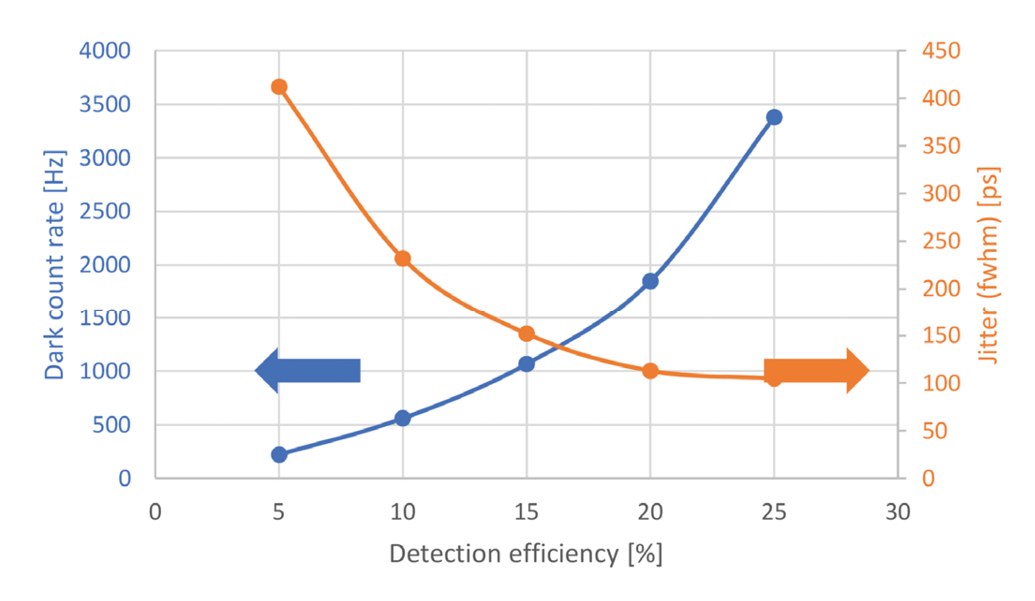
The electro-optical specifications of the SPAD Module are summarized as follows:
| Parameter | Parameter Value/Range | Note |
|---|---|---|
| Wavelengh range | 1000 nm to 1600 nm | typ. λ = 1550 nm |
| Efficiency | 10 - 25 % | @ λ = 1550 nm |
| Dark count rate | 10 %: 1.3 kHz (typ. 800 Hz) | - |
| 15 %: 2.7 kHz (typ. 2.5 kHz) | ||
| 20 %: 5.1 kHz (typ. 3 kHz) | ||
| 25 %: 10 kHz (typ. 5.1 kHz) | ||
| Timing jitter | ~200 ps @ 10 % | @ 25% efficiency |
| ~150 ps @ 15 % | ||
| ~120 ps @ 20 % | ||
| ~100 ps @ 25 % | ||
| Deadtime range | ~100 ns to 80 µs | in 100 ns steps |
| Optical coupling | SMF-28 optical single-mode fibre Pigtail L = 100 cm | - |
| Output signal format | 1.0 V low, 1.5 V high | into 50 Ω single ended (CML) |
| Output connector | SMA | - |
| Dimensions (W × H × L) | 140 mm * 60 mm (OEM Version) | - |

Graphical User Interface – SPAD Controller Tools

The SPAD Controller Tools are graphical user interfaces designed to configure and monitor SPAD modules. They provide full access to all relevant module parameters and display them in real time, allowing users to immediately observe operating conditions and any changes. Each interface is divided into clearly structured sections covering detector settings, high-voltage supply, temperature control (TEC), and test-signal generation. All values are shown live to ensure precise and transparent monitoring.
In the Basic View (top-left tab), the tools also offer a simplified overview of essential parameters – such as detection rate, bias voltage, and temperature – across multiple connected detectors. This enables quick comparison and efficient oversight in multi-detector setups.
Applications
- Quantum Key Distribution (QKD)
- Quantum communication and computing systems
- Quantum sensing applications
- High Dynamic Range (HDR) time of flight measurement (OTDR, LIDAR)
- Fluorescence lifetime measurements
- Singlet oxygen measurement
- FLIM, FRET
- IC inspection

Application Examples
Quantum Key Distribution (QKD) and Quantum Networks
Quantum Key Distribution (QKD) and Quantum Networks
The Single Photon Detection Module enables high-precision photon detection in quantum key distribution (QKD) systems operating over fiber and free-space channels. Its low dark count rate and timing jitter below 170 ps ensure stable key generation even under high-loss or dynamically routed conditions.
The module has been successfully employed in clock-channel-free QKD field trials. The system demonstrated the autonomous synchronization and seamless continuation of secure key exchange after optical path rerouting or link interruptions of several minutes.
This robustness makes it ideally suited for future software-defined quantum networks and scalable deployment of quantum key distribution.
Quantum Communication and Computing
Quantum Communication and Computing
In quantum communication and computing experiments, the SPAD Module provides low-jitter coincidence detection and stable free-running operation for photon correlation, entanglement analysis, and Bell-state measurements.
In multi-channel setups, the Single Photon Detection Module enables scalable coincidence setups for entanglement-based QKD and photon-source characterization in laboratory and field environments.
Optical Time Domain Reflectometry (OTDR) and LiDAR
Optical Time Domain Reflectometry (OTDR) and LiDAR
For photon-counting distance measurements, the SPAD Module offers sub-nanosecond time resolution and a high dynamic range.
These characteristics enable precise time-of-flight analysis for LiDAR and distributed optical sensing applications, such as structural health monitoring or fiber fault detection.
The module’s temperature-stabilized operation ensures repeatable measurements even under varying environmental conditions.
Fluorescence Lifetime and Biomedical Imaging
Fluorescence Lifetime and Biomedical Imaging
The SPAD Module is fully compatible with time-correlated single-photon counting (TCSPC) systems used in fluorescence lifetime imaging (FLIM) and Förster resonance energy transfer (FRET).
Its adjustable deadtime and threshold parameters allows optimizing count stability and minimize afterpulsing, providing reliable lifetime analysis across a broad spectral range.
Applications include biomedical diagnostics, singlet oxygen detection, and integrated circuit (IC) inspection, benefiting from the module’s compact form factor and software-configurable operation.