
The optical line terminal-optical time domain reflectometer (OLT-OTDR) dataset is a dataset published by the Fraunhofer Heinrich-Hertz Institute in collaboration with ADTRAN Network SE during the FRONT-RUNNER project funded by the German Ministry of Education and Research (BMBF) (16KISR008, 16KISR006).
Overview
This dataset collection includes OLT-OTDR measurements designed specifically for fault classification and localization in passive optical networks (PONs). All datasets share the same data structure and were collected from three experimental testbeds located at Fraunhofer HHI (Berlin), ADTRAN Networks SE (Munich), and ADTRAN Networks SE (Meiningen). Each testbed was built to support a variety of faults, covering both feeder fibers and the optical distribution network (ODN). The dataset includes six fault types: feeder fiber tap, feeder fiber cut, distribution fiber tap, distribution fiber cut, unplugged optical network unit (ONU), and powered-off ONU. Each sample captures measurements from both the OLT and OTDR, providing complementary information for accurate fault classification and localization. From the OLT we collect the received optical power values for each ONU, while from the OTDR we collect deep PON analysis traces (DPA). DPA traces are obtained by processing OTDR traces using a proprietary algorithm from ADTRAN, as described in [1]. In total, the dataset comprises more than 2000 samples, with class distribution summarized in Table 1. For the Berlin testbed, augmented data is also provided to facilitate training of AI models. All the data samples have been collected experimentally by repeatedly introducing each of the described faults into the network. For emulating fiber tapping we used a device known as fiber tester in the Meiningen testbed. A fiber tester bends the fiber and measures the intensity of the escaping light. In our scenario a ~3dB attenuation was recorded in Meiningen. As a fiber tester was not available in Berlin and Munich, we just emulated the tapping using a 3dB attenuation as suggested by the experiments in Meiningen.
Table 1. OLT-OTDR Dataset
a)
| Premises | Feeder Fiber Tap | Feeder Fiber Cut | Distri-bution Fiber Cut | Distri-bution Fiber Tap | Un-plugged ONU | Powered-Off ONU | Total |
|---|---|---|---|---|---|---|---|
| Berlin | 56 | 56 | 192 | 76 | 192 | 12 | 584 |
| Meiningen | 6 | 7 | 16 | 14 | 16 | 8 | 67 |
| Munich | 0 | 31 | 46 | 57 | 45 | 3 | 182 |
b)
| Premises | Feeder Fiber Tap | Feeder Fiber Cut | Distri-bution Fiber Cut | Distri-bution Fiber Tap | Un-plugged ONU | Powered-Off ONU | Total |
|---|---|---|---|---|---|---|---|
| Berlin | 56 | 56 | 852 | 76 | 852 | 12 | 1904 |
| Meiningen | 6 | 7 | 16 | 14 | 16 | 8 | 67 |
| Munich | 0 | 31 | 46 | 57 | 45 | 3 | 182 |
Testbed Description
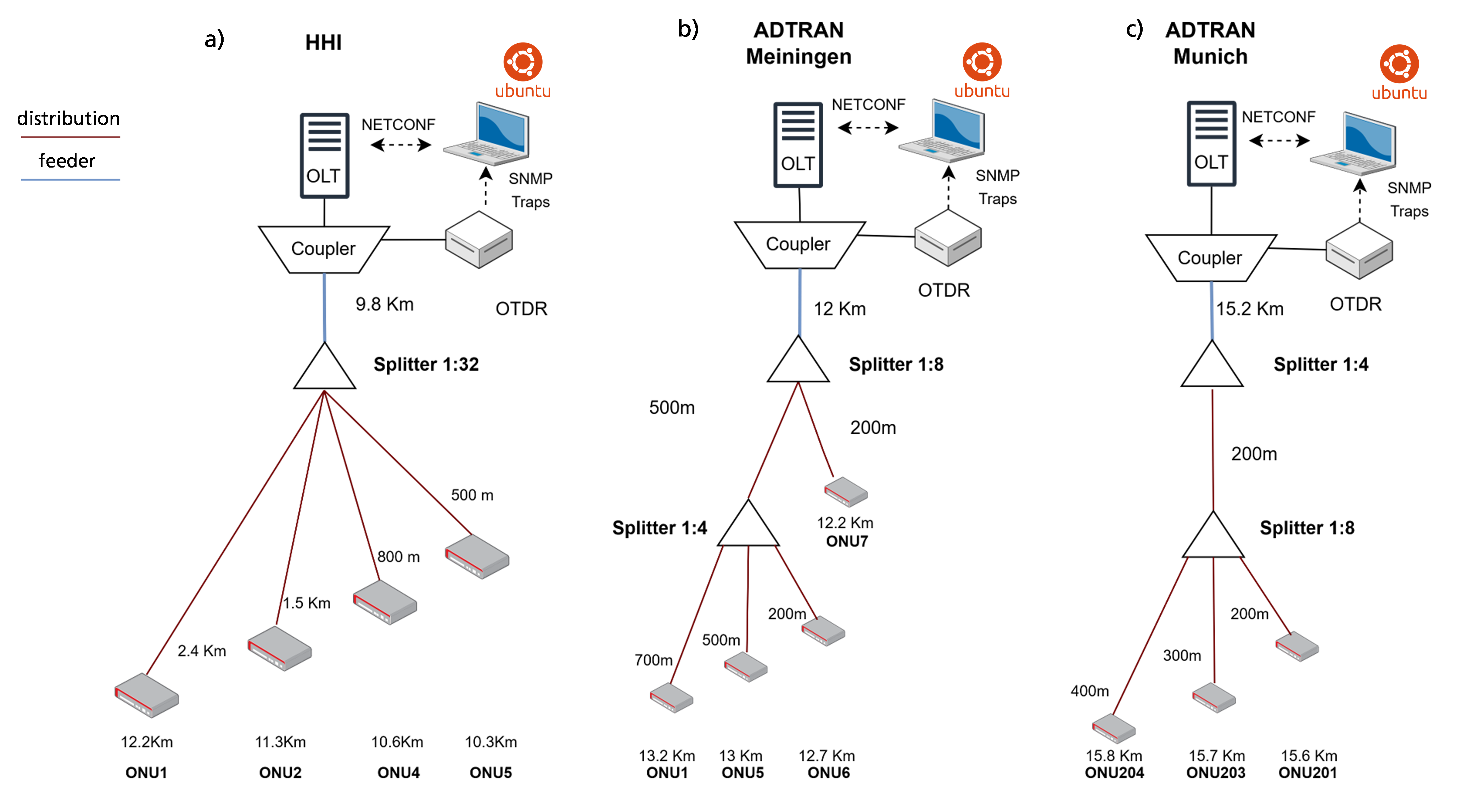
Data was collected across three PON testbeds (Figure 1), each using an Ubuntu 22.04 server to run the collection algorithm. The server communicates with the OLT (ADTRAN SDX 6320) via NETCONF and with the OTDR (ADTRAN ALM-1650D) via SNMP, while GPON ONUs (ADTRAN SDX611/SDX611Q) are deployed. An ADTRAN software on the server interfaces with the OTDR through an HTTP API. The OTDR provides two kinds of traces: a reference trace, used to set a baseline and define monitoring points, and a fault analysis trace, generated after an alarm and containing the reflectivity data that triggered it.
Dataset Structure
The dataset is organized into three main folders—Berlin, Meiningen, and Munich—each corresponding to a testbed. Data is stored as JSON files grouped by collection campaigns, which can be split into partitions, each linked to a reference trace.
There are three file types:
- Reference traces: include optical_power, distance, and reference_trace
- Augmented data: include optical_power and fault_analysis_trace
- Fault analysis traces: include optical_power, distance, and fault_analysis_trace
Files follow a self-explanatory naming format: affectedElement_faultType_location_number, where the number distinguishes duplicates.
Tasks
This dataset aims to support the development of algorithms for improving passive optical networks resilience when leveraging OTDR data. The innovation of this dataset consists in combining OLT information with OTDR traces to simplify the fault classification and localization process in PON.
Files
The dataset files are available for download on this webpage. If you are interested in receiving the dataset, please follow the link.
Subject Keywords
Optical Line Terminal, Optical Time Domain Reflectometry, Passive Optical Networks, Fault Classification, Fault Localization, Experimental Dataset
Conflicts of Interest
The authors have no conflicts of interest to declare.
References
[1] ADTRAN, PON Infrastructure Monitoring: Adtran’s deep PON assurance (DPA) technology, 2023
https://www.adtran.com/en/resources/resources-gated-page/solution-briefs/pon-infrastructure-monitoring