
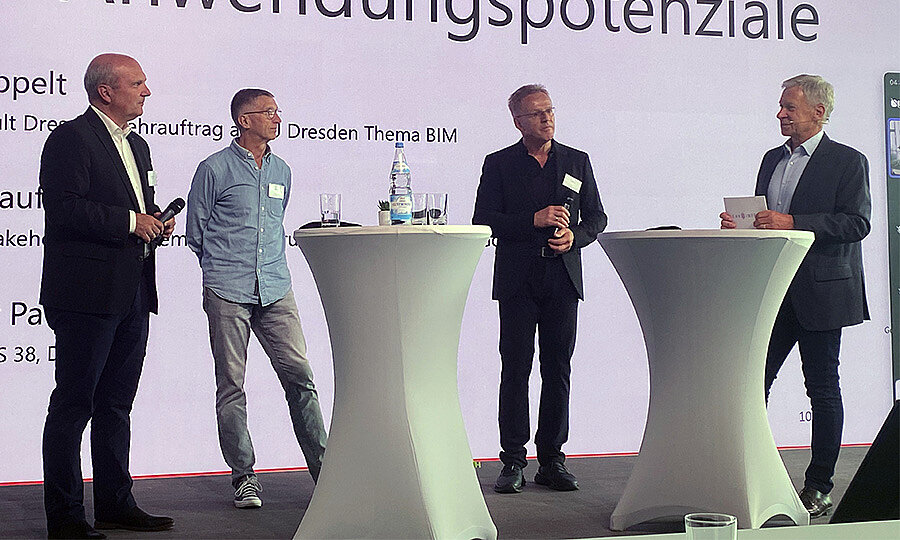
The results of the research project funded by the Federal Ministry for Economic Affairs and Energy (BMWE) – Real-time calculation, auralization, and visualization of sound propagation and noise protection measures for infrastructure projects (EAV-Infra) – were presented at an event held in early September at the Digital Technologies Forum in Berlin. At the same time, the numerous participants from industry and science were able to gain direct insight into the noise protection planning of tomorrow at a total of seven so-called demonstrators.
The main focus of the project was to automate the planning of noise protection measures for transport projects and, at the same time, to contribute to greater acceptance through audiovisual simulations. “With EAV-Infra, we have reached an important milestone on the way to digital and, at the same time, citizen-oriented noise protection planning for infrastructure projects. The decisive factor now will be to use the innovative technologies in specific projects and to further optimize them,” said Christian Weissig, head of the Capture/Display Systems Group at the Fraunhofer Heinrich Hertz Institute and one of the partners in the consortium for the joint project consisting of A+S Consult GmbH, Möhler + Partner Ingenieure GmbH, Fraunhofer Heinrich Hertz Institute (HHI), and Deutscher Eisenbahn Service AG. HHI contributed its experience in audiovisual simulation of transport infrastructure and auralization to the project.
The core technology of EAV-Infra is the digital planning method Building Information Modeling (BIM). The innovative technologies developed in the project on the basis of BIM make it possible to automate and thus accelerate the previously time-consuming planning processes for noise protection. At the same time, auralizations (“audible representations”) and visualizations of future noise situations can be generated. The realistic audiovisual representation of planning scenarios, for example in VR applications, thus becomes a valuable tool for citizen-oriented communication. Subsequently, the feedback of reactions to the simulation results into the BIM platform enabled the optimization of the planning itself.
For more than ten years, Fraunhofer HHI has been supporting Deutsche Bahn's new construction and expansion projects with audiovisual simulations of noise protection plans. Experience to date clearly shows that a realistic representation of noise protection is an important tool for credible public relations work. The results from EAV-Infra can help make simulations in combination with digital planning more efficient and cost-effective in the future. At the same time, the models can also be applied to other sources of emissions, such as construction noise. An ongoing pilot project will deliver its first results next year.
Find more information about the EAV-Infra project here.