

Overview
Precision, efficiency, and seamless integration — our Time Taggers (TDC, Time-to-Digital Converters) are the first choice for time-critical applications in research and industry. Developed in part for quantum key distribution (QKD) at the Fraunhofer Heinrich Hertz Institute, they enable highly accurate time measurement of individual electrical pulses in the sub-nanosecond range.
Our Time Taggers stand out through ultra-high stability, maximum flexibility, and an outstanding price-to-performance ratio. They integrate seamlessly into existing systems and can be individually adapted to specific requirements.
Time Tagger FMC – The FPGA-Native Solution
The Time Tagger FMC is the high-performance choice for FPGA-based high-end systems. Thanks to the widely adopted FMC connector, it can be deployed directly on numerous FPGA development platforms, significantly accelerating the development of new applications. With a time resolution of 100 ps, it is ideally suited for custom systems in research and development — as well as a modular expansion in production environments where maximum performance is required.
Time Tagger Device – the compact Plug-and-Play solution
The Time Tagger Device is the standalone alternative for a quick start: simply connect it to any computer via Ethernet and get started right away – with no need for specialized additional hardware or software. With a time resolution of 160 ps, a data throughput of up to 14 million detections per second, and temporal stability of 0.1 ppm, it is ideally equipped for demanding measurement tasks.
Both variants support multi-channel time-event detection and are ideally suited for applications such as QKD, LiDAR, and TCSPC.
Technical Highlights
| Time Tagger FMC | Time Tagger Device | |
|---|---|---|
| Time resolution | 100 ps | 160 ps |
| Connectivity | FMC Connector (FPGA) | Ethernet |
| Calibration | Not required | Not required |
| Application | Research & Industry | Research & rapid integration |
| Scalability | Fully customizable | Multi-channel |
| Availability | As device & IP core | As device |
| Input | DC coupled | DC coupled |
Thanks to DC coupling, even signals with long on or off times can be detected without any problems. The circuit can be easily adapted to different logic levels by setting the threshold and the polarity of the edge.


Applications
This technology is available for use in a variety of applications that require precise timing and detection of specific events. These include quantum communication, LiDAR, satellite laser ranging (SLR), time-correlated single-photon counting (TCSPC), and multi-channel scaling (MCS), where the accurate measurement of optical signal arrival times, down to single photons, plays a key role.
Application Examples
Quantum Key Distribution (QKD)
Quantum Key Distribution (QKD)

Quantum Key Distribution (QKD) relies on the HHI Time-Tagger to precisely identify single photons based on their arrival time. Each detection event is timestamped, enabling accurate qubit assignment across different detector channels.
Since photons may take paths of varying lengths, the Time-Tagger’s configurable offsets ensure precise compensation without additional software processing. Flexible settings for thresholds, signal edges, and dead times allow optimal adaptation to different single-photon detectors while effectively suppressing afterpulses and false signals.
The result: highly reliable, high-precision timing performance for advanced QKD systems.
Satellite Laser Ranging (SLR) and Incoherent LiDAR
Satellite Laser Ranging (SLR) and Incoherent LiDAR
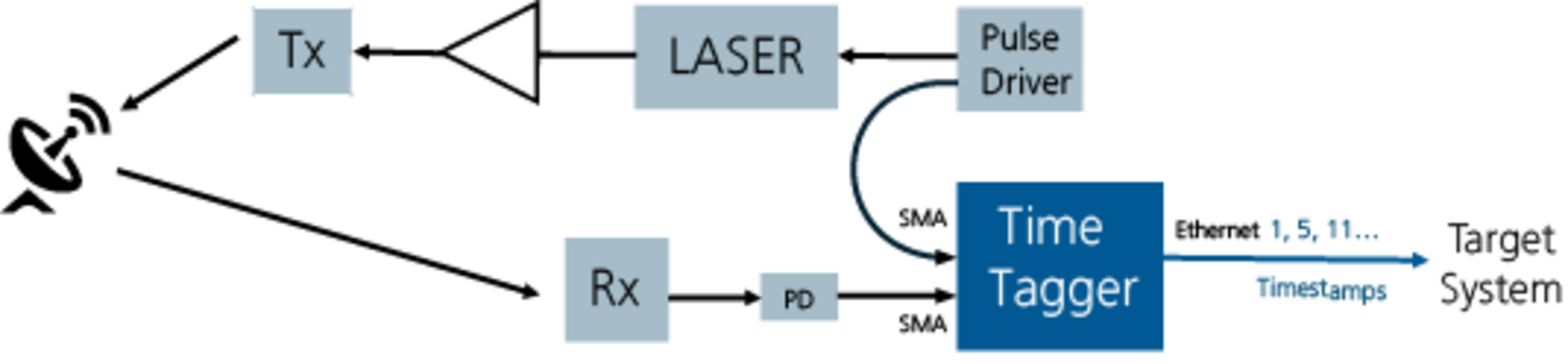
A laser generates short light pulses whose reflections are received by an optical antenna and converted into electrical signals by a photodiode. The Time-Tagger assigns precise timestamps to both the transmitted pulse and the received reflection. The time difference between these timestamps enables distance measurements with an accuracy of about 24 mm.
Configurable offsets and adjustable signal and edge settings ensure easy integration into existing setups and allow precise adaptation to the electrical characteristics of the photodiode and laser driver.