
The Backend and Packaging group addresses the complete process chain, ranging from the processing of photonic components at the chip level to the realization of fully functional optoelectronic modules. The backend activities primarily include chip singulation and optical thin‑film deposition of indium phosphide (InP) devices, thereby establishing the technological foundations required for subsequent integration.
Building on this, the packaging stage enables the reliable incorporation of these devices into application‑ready module architectures. This includes precise optical fiber coupling, the implementation of high‑frequency electrical interfaces, as well as the development of customized submounts and module prototypes for research and industry partners.
Backend
The Backend group develops and carries out processes for separation and optical coating of Indium-phosphide-chips (InP).
Device Separation
In the area of separation Fraunhofer HHI offers several processes for optical and optoelectronic components:
- Manual or fully automatic scribing and breaking of chips - individually, or up to several thousand per batch
- Bar cleaving from a width of 150µm
- Manual or automatic die sorting
- Visual inspection and documentation


Optical Coating
In the optical coatings lab, the group develops individual anti and high reflective coatings for edge- or surface-emitting photonic components.
Their ion beam sputtering process delivers reliably smooth and durable coatings. The process is stable and easily controlled, which enables the precise adjusting of reflectance of the optical devices.
In order to be able to process devices with varying measurements as well as large batches, the group works with a number of concepts of holders and jigs. The in-house workshop can individually adapt these holders to the components to satisfy the requirements of mechanical stress and overspray.
Packaging
The Packaging group constructs modules to demonstrate the capabilities of the optical and optoelectronic devices which are developed at Fraunhofer HHI. This includes optical fiber coupling as well as electrical interfaces with RF connectors.
Additionally they design and construct tailor-made module prototypes or submounts for all external partners and customers.


Housings
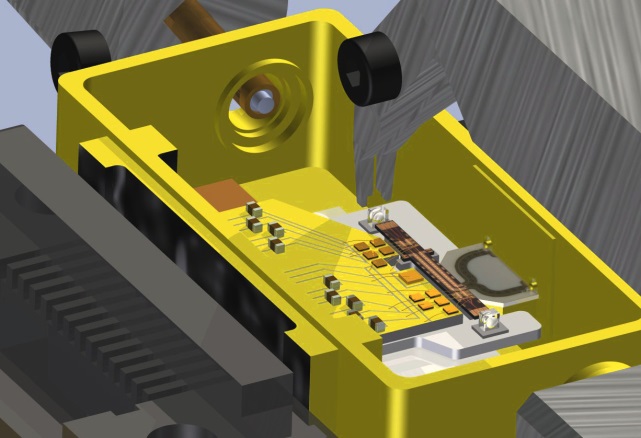
The module planning process begins with a 3D model of the whole assembly. The group either designs a customized housing or selects a standard BTF type depending on the usage and numbers required. Even small volumes of customized housings can be cost-efficiently constructed in the in-house workshop.
Optical Coupling
Fraunhofer HHI is experienced in using many coupling and fiber variants such as:
- Active and passive coupling
- Single mode and multimode fibers
- Polarization maintaining fibers
- Tapered fibers, butt fibers and customized arrays
- Lens coupling
Electrical Connections
The electrical connections of their chips include, alongside the biasing, the RF signal routing from the chip to the connector for frequencies up to 100 GHz and beyond.
The required circuit carriers are designed and produced on the premises:
- For applications up to 20 GHz we use laser structuring of metallized ceramic substrates which allows fast and individualized production
- When a higher degree of precision is necessary, electroplating of lithographically generated structures is used by the packaging group. Using ebeam lithography equipment makes this process fast and individually customizable as well.
The equipment to connect chips and interposers with various wire bonding and flip chip processes is also available:
Wire Bonding
- Gold and aluminum wire
- Ball and wedge bonding
- Deep access bonding
- Wire thicknesses from 17.5µm
- Manual or automated
- RF capable bonding up to 100 GHz
Flip Chip
- AuSn and SAC reflow
- Pastes and conductive adhesives
- Solder preforms
- AuSn sputtering
For chip assembly the group uses, alongside soldering, a large selection of adhesives whose mechanical, optical, thermal and electrical characteristics are tailored to the application in question. The montage is carried out manually or using machine assisted techniques to sub-micron positioning accuracy.