
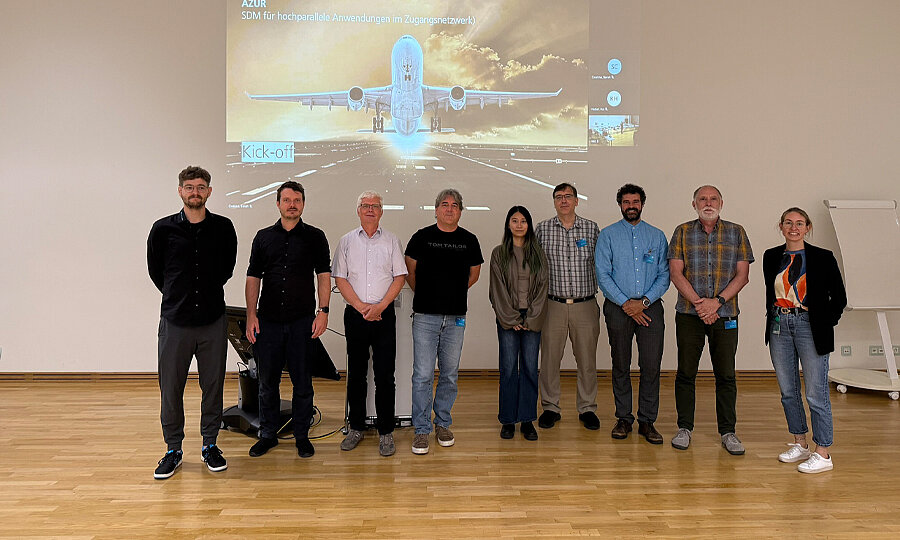
The Fraunhofer Heinrich Hertz Institute (HHI), together with its partners Heraeus Covantics, the University of Stuttgart and Printoptix, has launched the AZUR research project (SDM for highly parallel applications in access networks). The project is being funded by the German Federal Ministry of Education, Research and Space with 2.26 million euros and will run until November 2027.
The aim of the project is to develop new types of optical communication links based on space-division multiplex technologies. These enable significantly higher transmission capacity with lower system complexity. The aim is to make future access networks, such as fiber-to-the-home (FttH), more efficient. Applications in the field of artificial intelligence (AI) in particular, which generate and process large amounts of data, can thus be supported in the long term.
“With AZUR, we are demonstrating how space multiplexing can be used in access networks to enable more capacity with less complexity - a key technology for the networked society of tomorrow,” explains Sarah Cwalina, technical project manager at Fraunhofer HHI.
Fraunhofer HHI is contributing its expertise in optical communications to the project. It analyzes real-world application scenarios, develops system concepts for access networks and data centers, and plans the technical demonstrators. In addition, precise test setups are designed and implemented to test new components under realistic conditions—such as special fiber optic connections for particularly data-intensive applications. A tangible example: In order for multiple 8K video streams to run simultaneously and without interference over a single fiber optic connection in the future, innovative solutions such as those being developed in the AZUR project are needed.
The project was launched on July 23, 2025 with an official kick-off meeting. Representatives of all partners met at Fraunhofer HHI to coordinate the first work packages and plan the next steps together.