
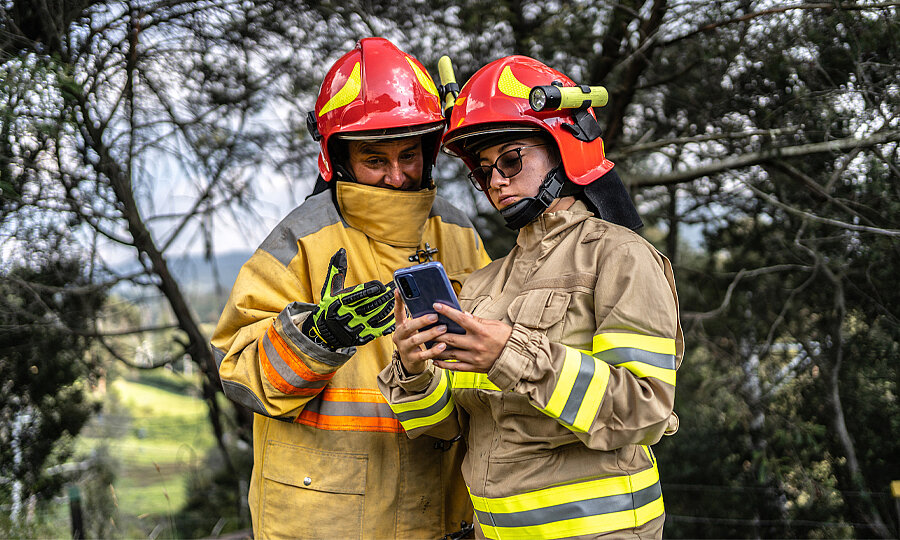
The Fraunhofer Heinrich-Hertz-Institut (HHI) has launched the new PICANT-BOS research project. The aim of the project is to develop temporary, broadband communication solutions based on 5G and Wi-Fi for use by authorities and organizations with security tasks (BOS – German: Behörden und Organisationen mit Sicherheitsaufgaben) - such as the police, fire department and rescue services.
With the increasing use of digital technologies such as drones, camera systems and sensor-based applications, the demands on the communication infrastructure in use are growing. Existing systems such as TETRA or public 5G are reaching their limits, particularly in the event of major emergencies or in buildings.
As part of PICANT-BOS, ad-hoc Wi-Fi and 5G networks are therefore being developed in the so-called lightly licensed spectrum (LLS). These are intended to provide additional, secure and powerful communication resources. Plans include a Wi-Fi network in the 6 GHz LLS band and a private 5G network in the 3.7-3.8 GHz range. These networks will be extensively tested in terms of resilience, scalability and interoperability. A particular focus is on integration with public mobile radio networks and the existing TETRA system.
BOS-specific applications for use on site
The project is also developing mobile applications that bundle and process mission-relevant data on site - for example, to support incident command or to assess the situation in real time.
Fraunhofer HHI is responsible for the reference design, the development of the Wi-Fi LLS network and contributions to standardization in IEEE 802.11. Other project partners are the University of Rostock, ituma GmbH, INTERLEV GmbH, Dräger and telent GmbH. Associated partners are Nokia and MUGLER SE.
The project is funded by the Federal Ministry of the Interior and Homeland (BMI) as part of the “Innovations in broadband digital radio BOS” program. The project is scheduled to run until June 2026.
You can find out more about the project here.