
What are Photonic Neural Networks?
Photonic neural networks process information with light instead of electrical signals, implementing layers, weights, and nonlinear activations using optical components. Computation occurs as light propagates through the network via interference, phase shifts, and modulation. Operating directly on the full optical field (amplitude and phase), they preserve information often lost in photodetection and digitization. Combining passive circuits for linear operations with nonlinear elements, they offer fast, energy-efficient analog computing, ideal as optical pre-processors before electronic conversion.
The Platform for Photonic Neural Networks
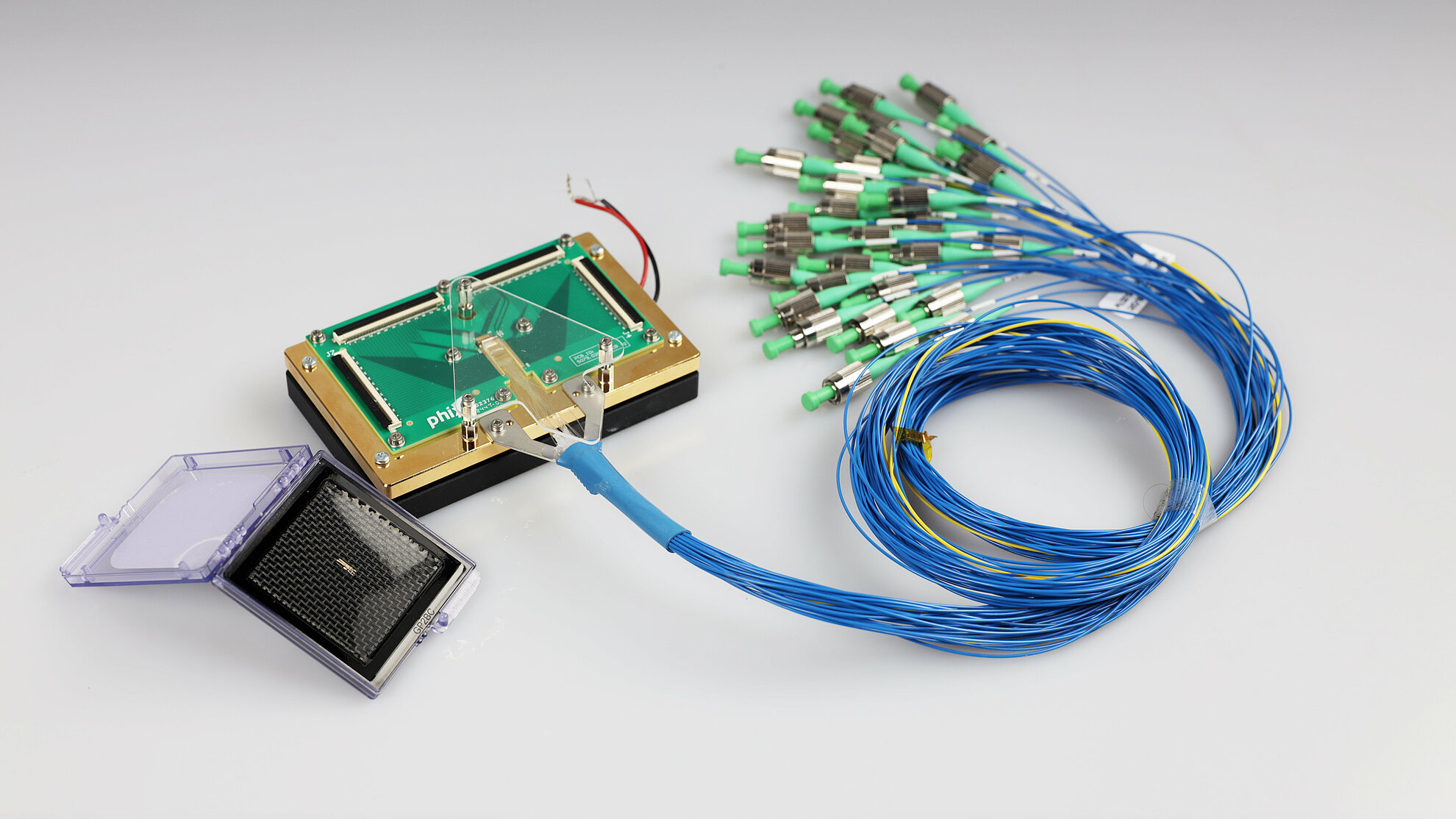
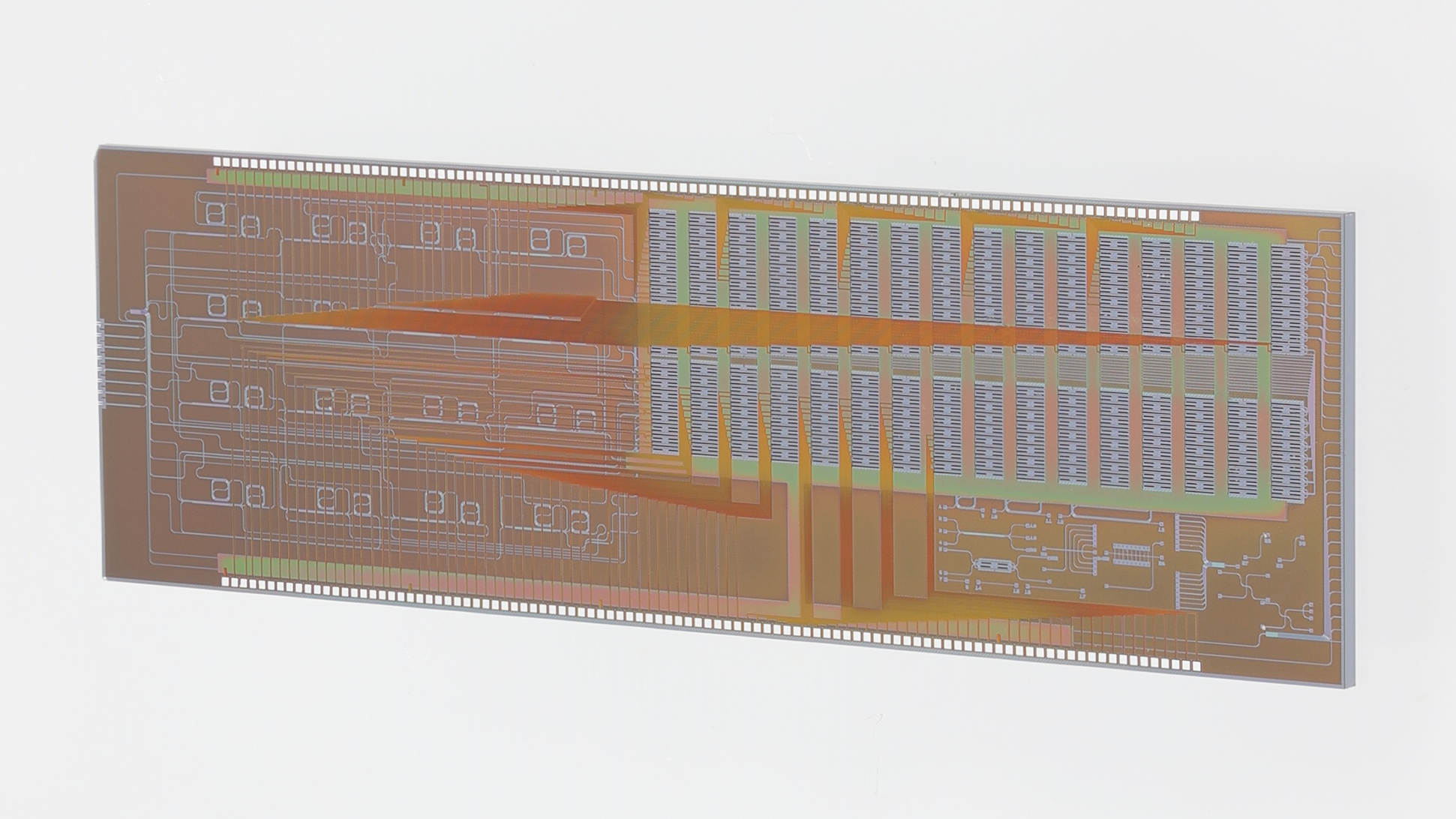
At Fraunhofer HHI, photonic neural networks are realized on integrated photonic chips, bringing optical “intelligence” down to the size of a fingernail. Depending on the architecture, we support multiple material platforms:
- Silicon nitride (SiN): low-loss passive circuitry and broadband operation
- Lithium niobate: fast and efficient modulation
- Indium phosphide (InP): integration of active components such as lasers and amplifiers
Heterogeneous integration at Fraunhofer HHI combines the strengths of different photonic platforms on a single chip, enabling photonic neural networks tailored to specific performance and integration requirements. The chips can be connected to existing systems via optical fibers, supporting both single- and multi-channel (SISO/MIMO) operation for parallel data processing. Eventually, our integrated photonic neural networks are compatible with established optical infrastructure and packaging approaches.
Furthermore, photonic neural networks could also be implemented in free-space optics, for example in front of CMOS cameras.

Photonic Neural Networks Tailored to Your Application
Imagine an optical system that not only transports or measures light, but interprets it in real time. Photonic neural networks turn optical front ends into trainable, task-specific processors operating directly in the optical domain. Light no longer needs to be converted and digitized first - it becomes the medium for intelligent processing. To assess whether your application is a good fit, consider three questions:
- Is your information already optical (e.g. fiber links, optical sensors, LiDAR, imaging systems)?
- Do you want to extract more information from the signal, such as phase data without coherent detection? Photonic neural networks can act as compact optical pre-processors, improving sensitivity and robustness.
- Do you need to compensate for signal distortions caused by components, transmission channels, or reconfigurable network elements?
From the idea to your Photonic Neural Network: HHI as your partner
Fraunhofer HHI supports you along the full development path of a photonic neural network - from the initial concept to a tailored evaluation kit for your lab.
We design, simulate, and implement the complete photonic neural network architecture for your specific task, including material platform and system layout, and fabricate the photonic integrated circuit in-house. This ensures a streamlined process from specification to first samples.
Around the chip, we develop the required control electronics, packaging, and software, delivering either a chip-level solution or a ready-to-use evaluation module with well-defined optical and electrical interfaces. The result is a coherent hardware–software platform that can be integrated into your setup with minimal effort.
