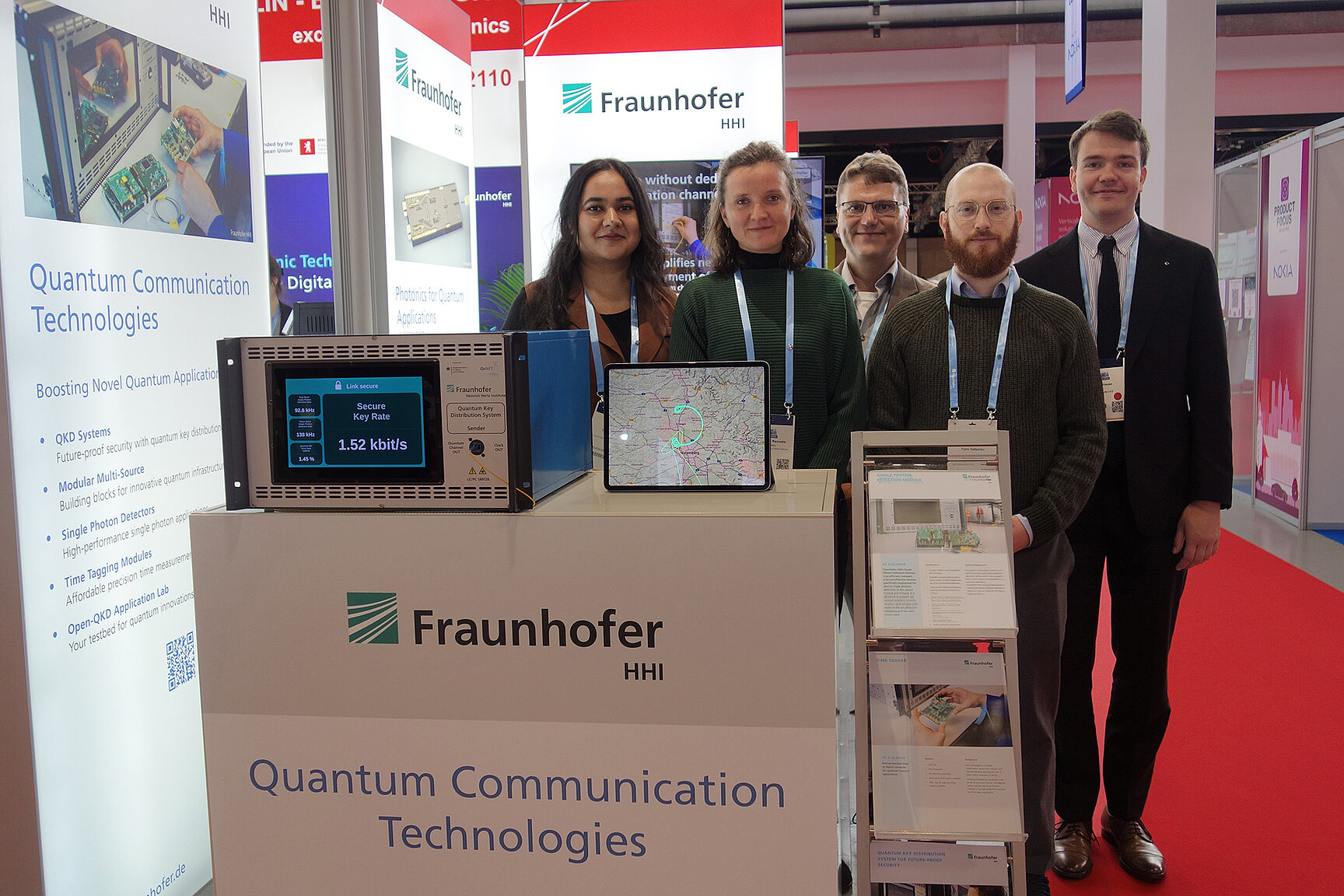
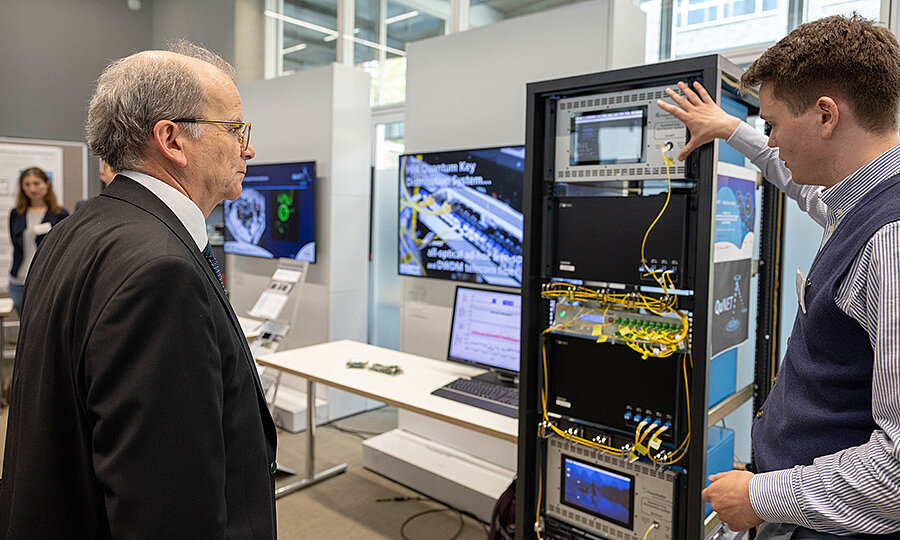
As part of the QuNET project, the Fraunhofer Heinrich Hertz Institute (HHI) is developing key technologies for the secure communication of the future—based on Quantum Key Distribution (QKD). The goal is to transfer physically tap-proof data transmission from the lab into real-world networks. Recently, Jan Krause, research associate at Fraunhofer HHI, presented the institute’s proprietary QKD system to Dr. Rolf-Dieter Jungk, State Secretary at the German Federal Ministry of Research, Technology and Space (BMFTR), during the QuNET Industry Workshop 2025—a striking demonstration of progress toward industrial application.
From Prototype to Practice: Fraunhofer HHI Shapes the Future of Secure Communication
In an interview, Jan Krause explains the role of Fraunhofer HHI within the QuNET project: “Our focus is on robust and straightforward integration into existing infrastructure—from photonic components and complete systems to security certification.” This level of vertical integration is unique. Fraunhofer HHI was the first institute worldwide to demonstrate the resilience of its QKD system against fiber interruptions and dynamic routing—a milestone for deployment in critical infrastructures.
600 Kilometers of Quantum Communication – Flexible and Realistic
Together with its partners, the institute demonstrated the secure exchange of personal identity data via QKD for government use cases in 2024. Now, Fraunhofer HHI is building a 600 km QKD link connecting Berlin and Frankfurt am Main. This link will connect political and digital hubs, forming one of the longest European quantum communication routes. Thanks to an innovative software-based approach, the system eliminates the need for a separate clock channel, simplifying network integration and significantly reducing costs.
Groundbreaking: QKD Takes Flight
In April 2025, Fraunhofer HHI, together with the German Aerospace Center (DLR), the Max Planck Institute for the Science of Light, and Fraunhofer IOF, achieved a QKD link between an aircraft and a ground station over 10 kilometers. This marks an important step toward mobile and satellite-based QKD nodes.
Compact, Efficient, Ready to Deploy: “QKD-in-a-Box”
The next stage of development is already underway: Fraunhofer HHI aims to miniaturize its systems, for example in the form of QKD plug-in cards or “Quantum SFP” modules. The goal is to easily extend existing hardware with QKD functionality. In-house developments, such as photonic integrated chips, single-photon detectors, and time taggers, form the technological foundation for this.
Further demonstrations are planned for the coming year, including a currently ongoing flight experiment and QKD tests between multiple German sites. Cross-border applications are also in preparation.
Why QKD Matters Now
Given the growing threats to IT infrastructures, quantum communication is gaining enormous importance. Fraunhofer HHI’s contributions show that QKD systems are ready for real-world deployment—across fiber networks, in urban infrastructures, over long distances, and even in the air.
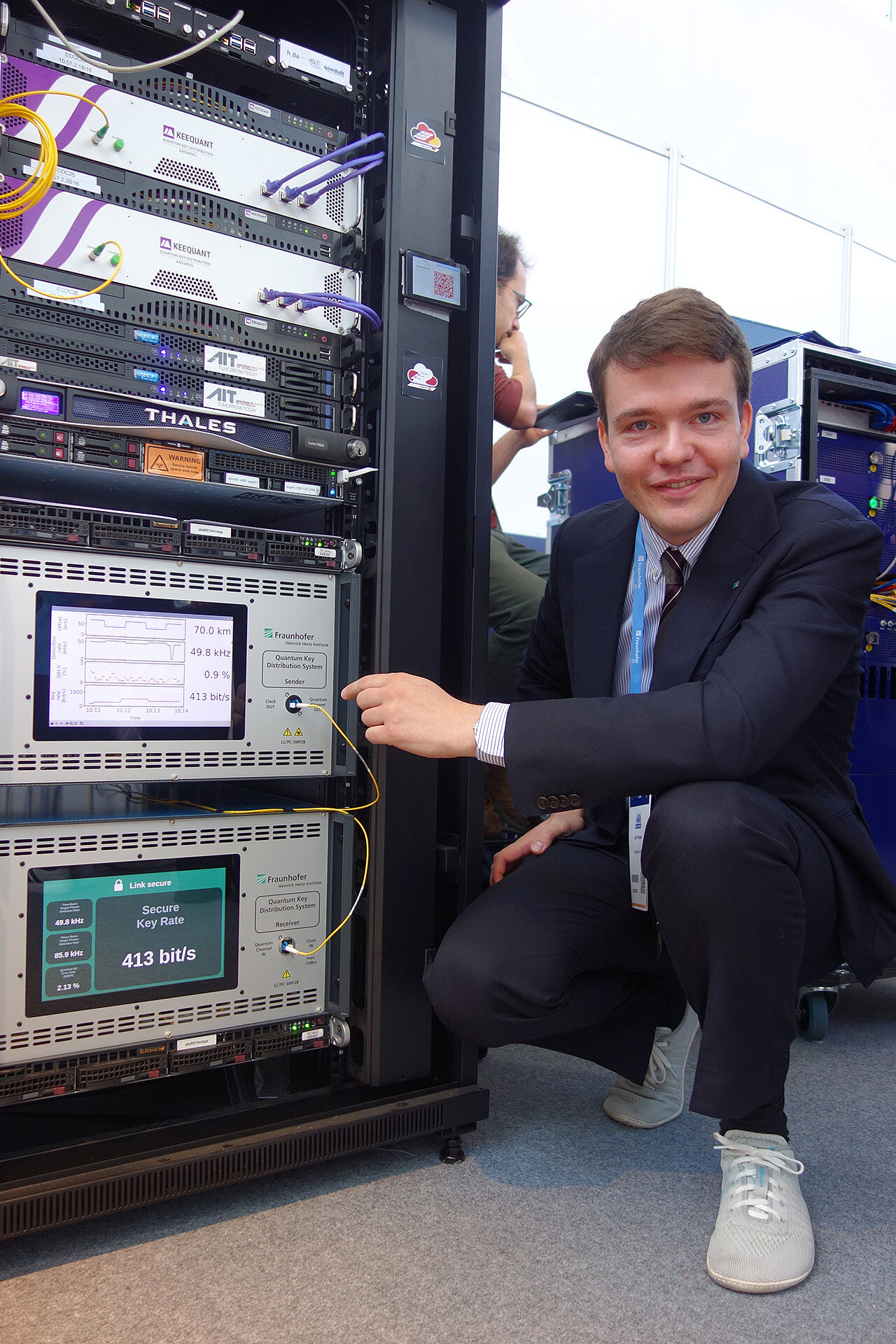
Read the full Interview with Jan Krause here:
Jan, what is the goal of QuNET—and what role does Fraunhofer HHI play?
In our increasingly digitalized society, we are becoming more dependent on eavesdropping-secure communication, especially in light of current geopolitical challenges. Technological sovereignty in this area is therefore becoming ever more crucial. Quantum communication (QKD) offers a fundamental approach to achieving physically secure data transmission.
QuNET’s goal is to transition this technology from research into practical application. At Fraunhofer HHI, we focus on robust and straightforward integration into existing infrastructures. Our contribution spans from developing key components, such as single-photon detectors, to complete systems, interfaces for network integration, and methods for validation and security certification of QKD systems. Such vertical integration is a true differentiator in this field.
Recently, we became the first in the world to demonstrate the resilience of our in-house QKD system to fiber interruptions and dynamic routing, proving that our systems are ready for industrial use under real-world conditions.
Last year, we also demonstrated secure transmission of personal identity data via QKD in a governmental context—a concrete use case for public authorities and critical infrastructures.
In another project, we are preparing systems for a 600 km tap-proof link between Berlin and Frankfurt am Main—one of the longest QKD connections in Europe.
What makes the QKD backbone between Berlin and Frankfurt so special?
The QKD relay link between Berlin and Frankfurt am Main will be one of the longest quantum connections in Europe.
Connecting these two metropolitan regions offers unique opportunities: on one end, we have the German capital with numerous federal ministries, and on the other the home to one of the world’s largest internet exchange points.
In addition, we have specifically enhanced our systems for this link. Thanks to a clever software concept, we can completely eliminate the traditional clock channel between systems. This greatly simplifies network integration and reduces costs.
Fraunhofer HHI has also demonstrated QKD in flight. What made that so special?
To cover long distances with QKD, it can be useful to connect distant points via mobile nodes, such as satellite relays. China demonstrated this approach in 2016 with the “Micius” satellite. Together with DLR, the Max Planck Institute for the Science of Light, and the Fraunhofer IOF, we established a QKD link between an aircraft and a ground station 10 kilometers apart in April. This is an important step toward future missions using mobile nodes.
How will the technology evolve from here?
We are currently working to further enhance the performance and robustness of our systems, with a particular focus on simplifying the integration into fiber-based networks. One of our main goals is to drastically reduce system size to improve energy efficiency and usability. Our vision is to realize QKD plug-in cards and “Quantum SFP” modules—compact QKD systems compatible with standard optical telecommunication form factors. This would allow existing hardware to be easily upgraded with QKD functionality. Here, our in-house developments in photonic integrated chips, single-photon detectors, and time taggers are key enablers.
We are also planning further demonstration experiments. Within QuNET, we will conduct QKD tests between several locations across Germany next year and are preparing new cross-border applications with partners.
Currently, we are carrying out another flight experiment with our QKD system—another step toward space-based applications. Combined with our strong expertise in free-space optics, we are well-positioned to make QKD space-ready. In the future, QKD systems could be integrated into satellites to enable secure links between distant locations. Exciting times lie ahead!