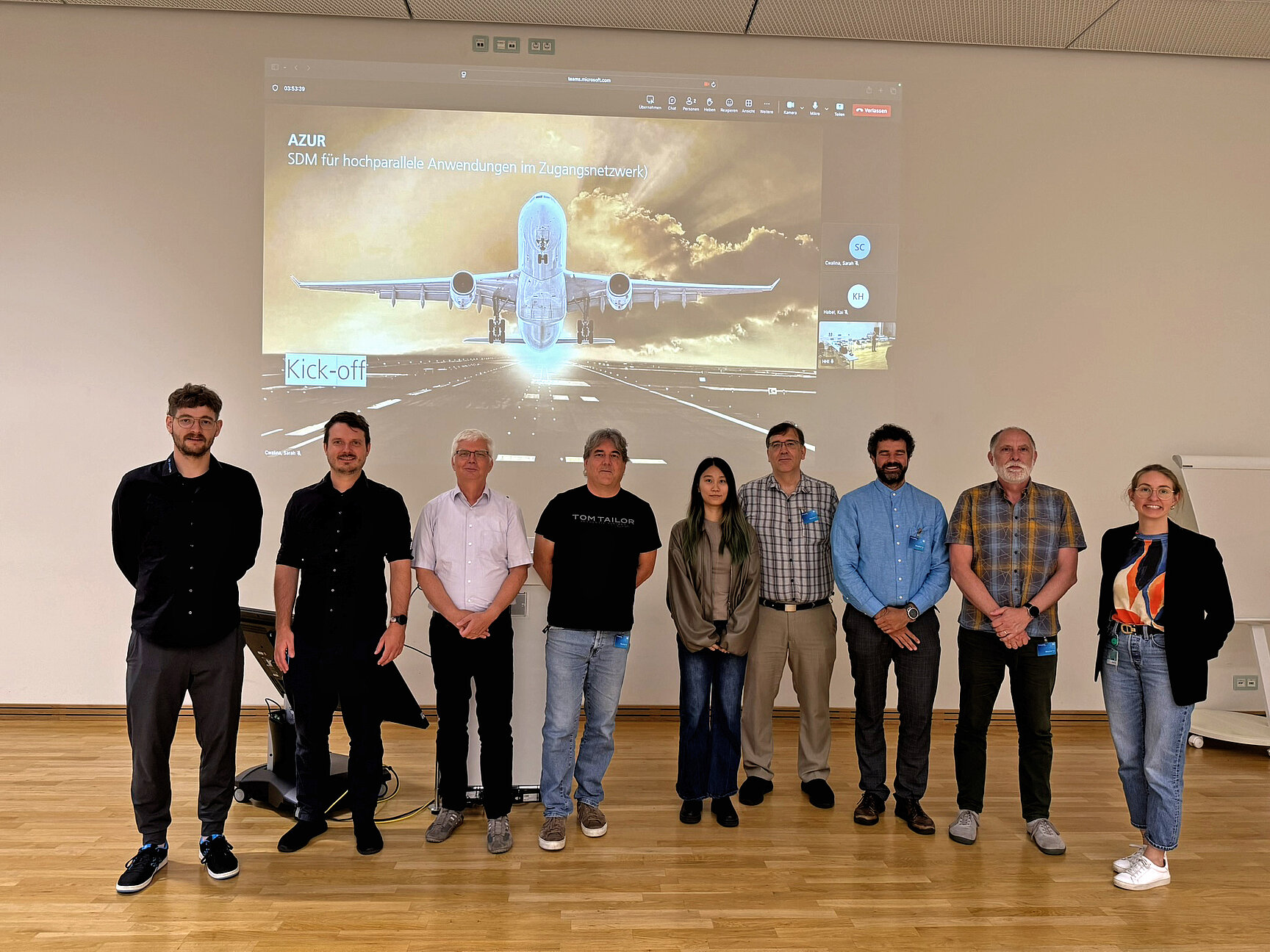


SDM for Highly Parallel Applications in Access Networks (AZUR)
Space Division Multiplexing in Optical Access Networks Using Multicore Fibers
Funded by the Federal Ministry of Research, Technology, and Space
Duration: June 2025 – May 2028
The steady growth in data traffic, driven by digitalization and new AI-based applications, poses major challenges for our networks. Innovative, cost-effective, and energy-efficient solutions are needed to provide the high data rates required. Access networks, which connect the core network to home connections in the so-called “last mile,” will also have to provide high data rates in the future. This means that innovative solutions must also be found in this area.
In this context, AZUR is researching high-performance optical communication connections based on mode and spatial multiplexing for short-range applications. Areas of application include access networks, in particular passive optical networks (PON), as well as the highly parallel optical connection of computing and AI centers. The guiding principle of the project is: greater efficiency with less complexity.
The work focuses on four core technologies:
1) Development and manufacture of multi-core fibers
2) MIMO DSP for mode and spatial multiplexing with reduced complexity
3) Efficient optical connection of highly parallel transmission channels
4) Interference-free optical sensor technology in networks with multi-core fibers
The innovative combination of space and mode multiplexing is giving rise to new solutions for optical signal processing and transmission technology. This enables cost-efficient access networks with significantly higher data rates.
Together with Heraeus Covantics, Printoptix, and the University of Stuttgart, and coordinated by Fraunhofer HHI, the project consortium is strengthening Germany's technological sovereignty and specifically expanding its technological lead in spatial multiplexing technologies.